> For the complete documentation index, see [llms.txt](https://framework.ishare.eu/llms.txt). Markdown versions of documentation pages are available by appending `.md` to page URLs; this page is available as [Markdown](https://framework.ishare.eu/detailed-descriptions/functional/primary-use-cases/1.-m2m-service-provision/1d.-m2m-service-provision-with-verifiable-credentials.md).
# 1d. M2M service provision with Verifiable Credentials
This subsection shows how [**1a**](/detailed-descriptions/functional/primary-use-cases/1.-m2m-service-provision.md), [**1b**](/detailed-descriptions/functional/primary-use-cases/1.-m2m-service-provision/1b.-m2m-service-provision-with-the-ep-as-the-delegation-info-pip.md), and [**1c**](/detailed-descriptions/functional/primary-use-cases/1.-m2m-service-provision/1c.-m2m-service-provision-with-the-ar-as-the-delegation-info-pip.md) change when using **Verifiable Credentials (VCs)**. With VCs, the execution becomes a single, standard flow; the only difference across variants is who issues the DataRights Credential and how the Machine Service Consumer (MSC) obtains it before calling the Service Provider (SP).
### General prerequisites (VC):
* The Machine Service Consumer (MSC) can hold credentials and create a Verifiable Presentation (VP) upon request;
* The Service Provider (SP) can request and verify VPs (signatures, keys, issuer trust, credential schema, credential status/revocation, and validity window);
* Parties have been issued ParticipantCredentials issued by the Participant Registry during onboarding (evidence of iSHARE adherence);
* Parties can verify each other's credentials upon request (to verify iSHARE adherence, revocation status, and trusted issuer lists when applicable).
{% hint style="info" %}
These credential verification checks (revocation status and whether the credential was issued by a trusted credential issuer) are assumed in every step, even if not explicitly described in the diagrams.
{% endhint %}
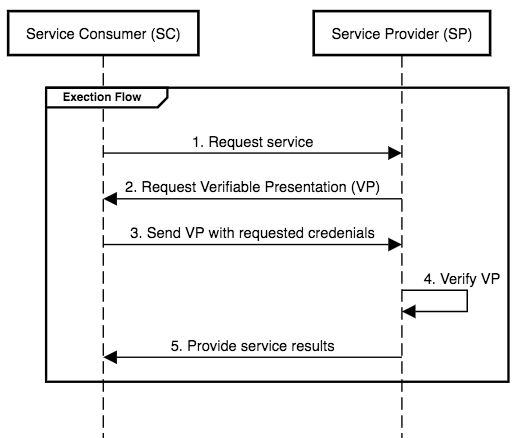
### General Execution Flow
1. Service Consumer requests service from Service Provider;
2. Service Provider requests Verifiable Presentation (VP) from Service Consumer;
3. Service Consumer sends the VP with all requested credentials to the Service Provider;
4. Service Provider Verifies VP (iSHARE adherence, signature, keys, issuer trust, schema, revocation status, validation window);
5. Service Provider provides service results to Service Consumer.
{% hint style="info" %}
Steps **1-3** may be combined if the SC includes a VP (with all the required credentials) in the initial request.
{% endhint %}
### 1a. M2M service provision (SC = EP)
No third-party delegation is needed. The Service Consumer (SC) is also the Entitled Party (EP) and already has the right.
#### **Sequence Diagram**
***
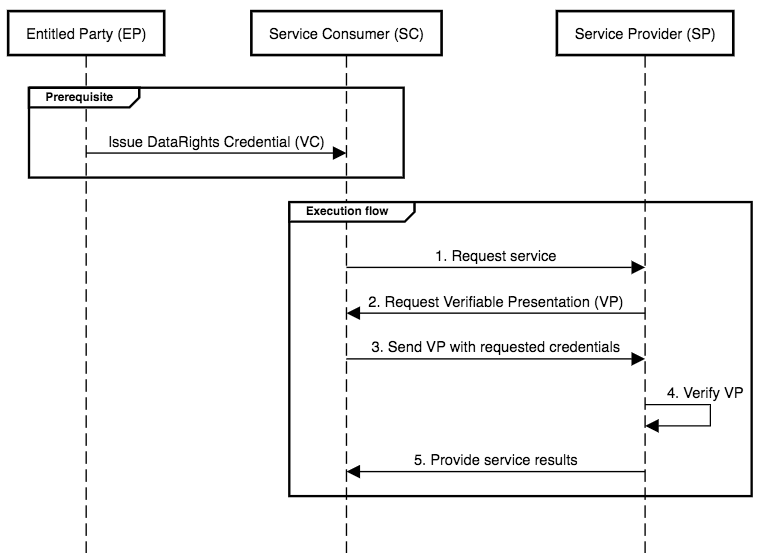
### 1b. M2M service provision with the **EP** as the delegation info PIP
The Entitled Party expresses delegation by issuing a DataRights Credential (VC) to the SC/MSC as a prerequisite.
#### **Sequence Diagram**
***
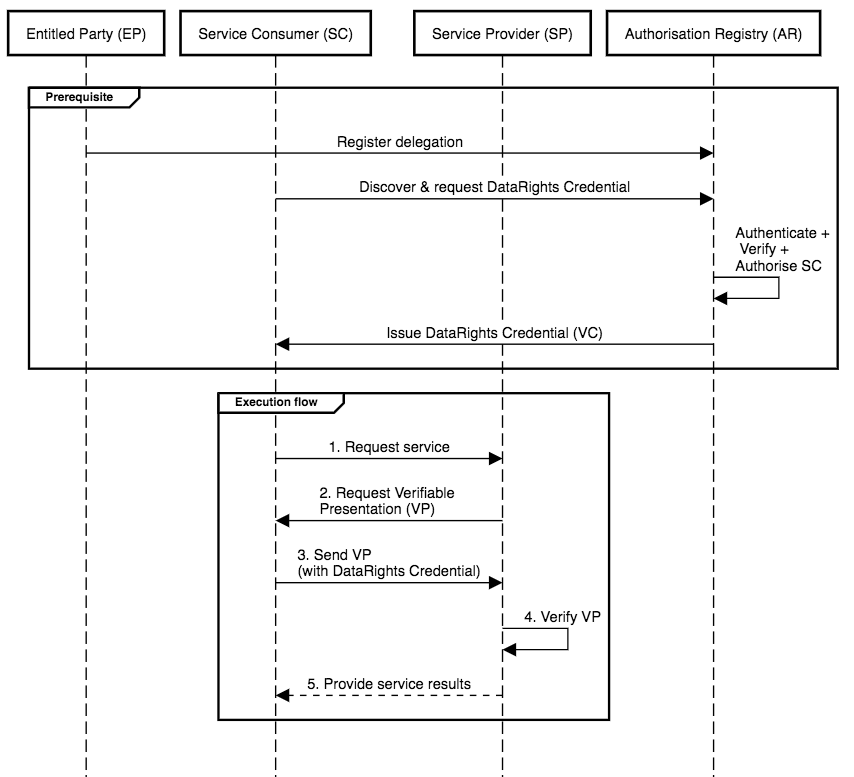
### 1c. M2M service provision with the **AR** as the delegation info PIP
The Authorisation Registry stores the delegation information of the Entitled Party. The Service Consumer first discovers the Authorisation Registry (following Authorisation Registry discovery logic) & requests a DataRights Credential.
#### **Sequence Diagram**